The SEO Survival Guide: How to Conquer the Search Jungle (and Not Get Eaten by Algorithms)
Introduction: Welcome to the Wild West of the Web!
Ever wonder how some websites magically appear at the top of Google’s search results, like a mirage shimmering in the digital desert? It’s not magic, my friends, but the subtle art and science of Search Engine Optimization, or SEO. At its core, SEO is about ensuring your website can be found by search engines like Google—for free, mind you. We’re talking about organic traffic, the lifeblood of many online ventures.
Why does it matter, this dance with the algorithms? More visitors translate to more brand awareness, which, in turn, can lead to more customers. In the sprawling landscape of the internet, SEO is your compass, your map, and your survival kit all rolled into one. It’s the difference between thriving in the digital age and fading into obscurity, a forgotten whisper in the vast echo chamber of the web.
Part 1: A Blast from the Past – How We Got Here
- The Stone Age of Search (1990s):
Ah, the 1990s, a simpler time when the internet was a nascent experiment. Early search engines like Archie and WebCrawler were the digital equivalents of stone tools –clunky, but functional. Remember when AltaVista indexed over 20 million pages, marking the start of comprehensive search capabilities? Back then, the “hacks” of the day were as subtle as a sledgehammer: keyword stuffing, hidden text, and other deceptive practices ruled. It was the Wild West, a digital frontier where anything seemed possible. As the “Report on Web Search Click Measurement Biases” details, these early engines struggled with even basic relevance, often rewarding sheer volume of keywords over genuine content quality.
Then came Google in 1998, armed with PageRank, a revolutionary concept. This algorithm didn’t just count keywords; it analyzed the links pointing to a website, treating them as votes of confidence. Suddenly, quality mattered. It was a paradigm shift, a seismic event that would reshape the internet as we knew it.
- The Google Wars (2000s):
The new millennium saw Google’s ascent to dominance, a reign that continues to this day. AdWords monetized search, turning it into a lucrative advertising platform. But with power came responsibility, and Google began wielding its algorithmic stick. The “Panda” and “Penguin” updates were watershed moments, punishing websites with spammy content and shady link-building tactics. As the “Evolution of SEO Tactics” white paper notes, many SEO professionals had to adapt or perish, abandoning their old tricks in favor of more ethical strategies. The shift towards quality over quantity was in full swing.
And let’s not forget the quiet revolution brewing beneath the surface: the rise of mobile. The iPhone’s arrival signaled a new era, one where websites had to be accessible on the go.
- The Rise of Smart Search (2010s):
The 2010s marked a turning point, as Google’s algorithms evolved from mere keyword matchers to sophisticated interpreters of meaning. “Hummingbird” and “RankBrain” were the harbingers of this new age, capable of understanding intent and context, not just keywords. No longer could you simply stuff your pages with keywords and expect to rank; you had to truly understand what your audience was looking for.
“Mobilegeddon” arrived, a stark warning to websites that hadn’t embraced mobile-friendliness. If your site wasn’t optimized for smartphones, you were effectively invisible to a growing segment of the population. This decade also saw the rise of “E-A-T” (Expertise, Authoritativeness, Trustworthiness) as a crucial ranking factor. Building trust became paramount. Google started evaluating the credibility and reliability of websites, favoring those with demonstrable expertise and a solid reputation.
Part 2: The Three Pillars Holding Up Your Online Empire
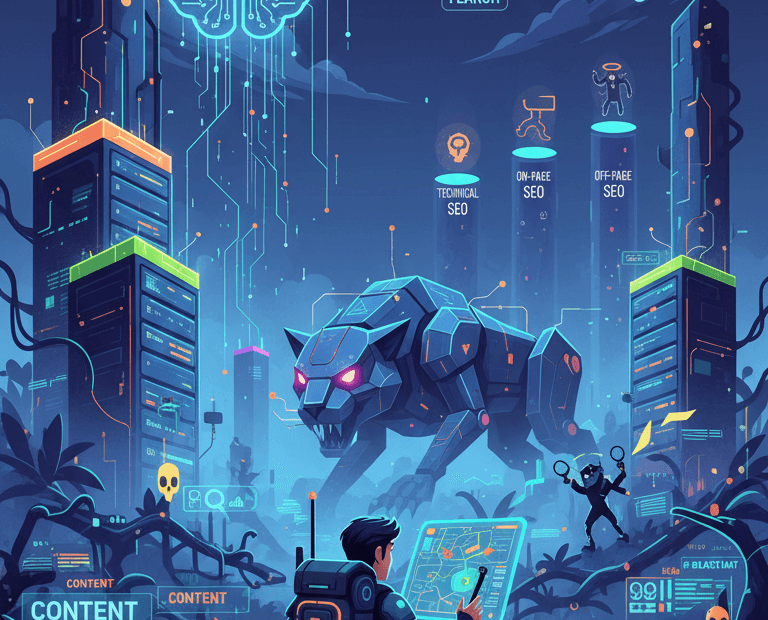
Imagine your website as a house. To stand the test of time, it needs a strong foundation, a beautiful interior, and good curb appeal. In the world of SEO, these elements translate into technical SEO, on-page SEO, and off-page SEO.
- 1. Technical SEO: The Unseen Foundations
Technical SEO is the bedrock upon which your online presence is built. It’s about ensuring search engines can actually find and read your site. Without proper crawlability and indexability, your website is effectively invisible to Google. As the “Technical SEO Audit Checklist” emphasizes, this involves optimizing your site’s architecture, ensuring proper robots.txt configuration, and creating a comprehensive sitemap.
Site speed is another critical factor. Nobody likes a slow website, least of all Google. The “Core Web Vitals” initiative underscores the importance of fast loading times and a smooth user experience. Mobile-friendliness remains crucial in 2026. And security (HTTPS) is non-negotiable; Google prefers secure sites, and so should your visitors.
- 2. On-Page SEO: Making Your House Inviting
On-page SEO is about making your website appealing to both users and search engines. It starts with creating amazing, helpful content that answers user questions. Keyword use is still important, but it should be smart and strategic, not forced or unnatural. Focus on crafting compelling titles, descriptions, and headings that incorporate relevant keywords.
Organize your content logically, using H1s, H2s, and other heading tags to improve readability. Internal linking is essential for guiding visitors (and search engines) through your site, helping them discover related content and understand your site’s structure.
- 3. Off-Page SEO: Building Your Reputation in the Neighborhood
Off-page SEO is about building your website’s reputation and authority. Backlinks, those “votes” from other reputable websites, are still incredibly important. Think of them as endorsements from trusted sources. Social media mentions and brand visibility also play a role, as do online reviews, especially for local businesses. The “Link Building Strategies for 2026” report highlights the importance of earning backlinks from high-authority domains in your niche.
Part 3: The AI Takeover & The Great SEO Debate (Current Opinions & Controversies)
- The AI Content Rollercoaster:
The rise of AI has thrown the world of content creation into turmoil. Can AI write good content? Yes, it can, but the question is, should it? Google’s stance is clear: AI content is fine if it’s helpful and high-quality, adhering to the principles of E-E-A-T (Experience, Expertise, Authoritativeness, Trustworthiness). However, the dark side of AI content is the potential for mass-produced, low-quality spam. The March 2024 update hit these sites hard, penalizing those that prioritized quantity over quality.
The ethical use of AI is a crucial debate. AI should be a helper, assisting with ideas and outlines, not a content factory churning out endless streams of generic articles.
- Google’s Shady Secrets (or Lack Thereof):
The ongoing debate about transparency in Google’s algorithms continues to rage. How much should Google tell us about how its search engine works? The May 2024 leak offered a rare glimpse behind the curtain, sparking a flurry of speculation and analysis. Balancing transparency with the need to keep algorithms secure is a delicate act. Regulations like the Digital Services Act (DSA) are pushing for greater transparency, but the balance remains elusive.
- Black Hats vs. White Hats: The Eternal Struggle:
The age-old battle between black hat and white hat SEO continues. White hat SEOs play by the rules, focus on users, and build long-term success. They are the good guys, the ethical practitioners of the craft. Black hat SEOs, on the other hand, try to trick the system for quick gains, using tactics like keyword stuffing and link farms. They are the bad guys, the snake oil salesmen of the internet.
Why is black hat SEO a terrible idea? Because Google is getting increasingly sophisticated at detecting and punishing manipulators. The risk of de-indexing, of being banished from Google’s search results, is simply too great. Then there’s gray hat SEO, the blurry middle ground where practitioners tread carefully, attempting to push the boundaries without crossing the line. But even gray hat tactics can be risky, as Google’s algorithms are constantly evolving.
Part 4: Peeking into the Crystal Ball – The Future of Search (and Your Website!)
- AI Everywhere (and We Mean Everywhere):
The future of search is inextricably linked to artificial intelligence. Conversational search, where users ask questions as if talking to a friend, is becoming increasingly common. Search Generative Experience (SGE), now rebranded as AI Overviews, represents a fundamental shift in how Google presents information, providing direct answers and summaries. Is this an opportunity or a threat? It depends on how you adapt.
Large language models (LLMs) like ChatGPT and Gemini are becoming indispensable research assistants, capable of summarizing information and generating content outlines.
- Beyond Text: The Visual & Audible Web:
The web is becoming increasingly visual and audible. Voice search is the new normal, with users talking to their devices to find information. How does your content sound when read aloud? Visual search, exemplified by Google’s “Circle to Search” feature, allows users to search with images, opening up new possibilities for discovery. Multimodal search, combining text, images, and voice, is the next frontier, enabling complex and nuanced queries.
- Hyper-Personalization & Zero-Click Answers:
Search results are becoming increasingly personalized, tailored to individual users’ interests and preferences. Zero-click answers, where users get the information they need directly in the search results without clicking a link, are becoming more prevalent.
- The Human Touch Remains King:
Even with the rise of AI, genuine expertise, human experience, and trustworthiness (E-E-A-T, remember?) are more vital than ever. Creating truly helpful, people-first content is the ultimate long-term strategy. Algorithms come and go, but the need for authentic, valuable content remains constant.
Conclusion: Your Website’s Future in the Search Cosmos
SEO isn’t dead, it’s just evolving, morphing, and adapting to the ever-changing landscape of the internet. The key takeaways are clear: adapt, prioritize users, embrace ethical AI, and never stop learning. Don’t just chase algorithms; build a website that genuinely serves your audience, and the algorithms will follow.
What are your predictions for the future of search? Let us know in the comments below! What innovations do you think will become the norm? Will the human touch continue to triumph? Let’s discuss!