
For B2B service providers, tech founders, and specialized agency leads, a conversion is rarely as simple as a single “Add to Cart” click. In our world—where Hunabkuh thrives—a true “conversion” often starts a months-long sales cycle. A lead is not a customer until a complex negotiation finishes.
So, why are you using B2C CRO tactics on your B2B marketing engine?
Specialized B2B CRO requires a tectonic shift in perspective. You are not optimizing for impulsiveness; you are optimizing for trust. You are not trying to capture any email; you are trying to capture the qualified email of a decision-maker.
The standard generic advice will tell you to change your button colors or add social proof. In this definitive guide, we look deeper at the architecture required for high-ticket, enterprise-level B2B conversion rate optimization.
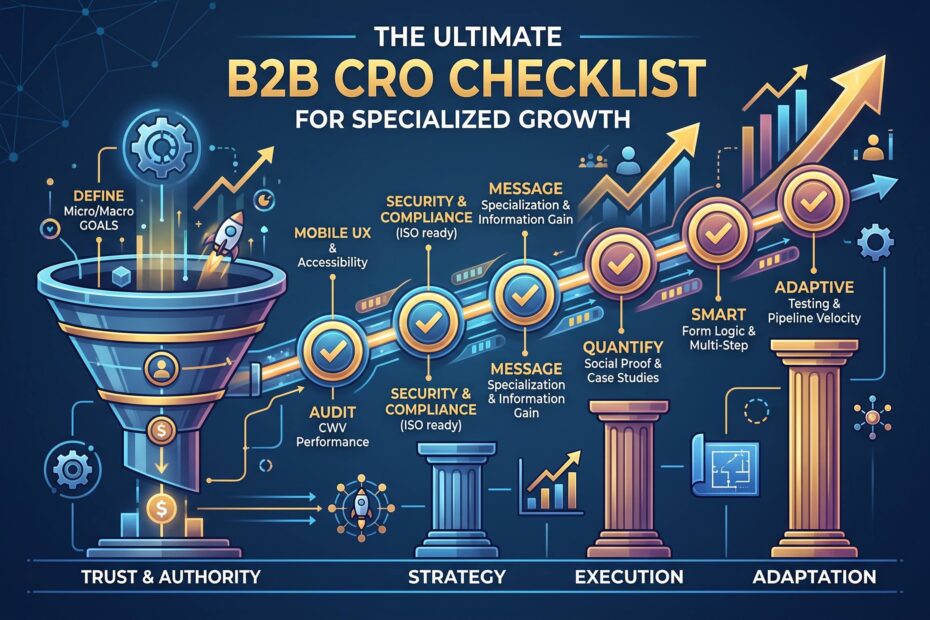
Phase 1: Strategic Intent & Goal Specification (The Strategy)
A specialized B2B website is not a passive brochure; it is an active sales engine. Before touching a single line of code or copy, you must define precisely what a “qualified conversion” means to your revenue pipeline.
1. Define Micro vs. Macro Conversions
In B2B, a macro conversion (e.g., “Request a Demo,” “Consult with an Expert”) is rarely the first interaction. You must track and optimize for the entire journey:
- Micro Conversions: Newsletter signup, webinar registration, logic-based quiz completion, whitepaper download. These build topical trust and warm the lead.
- Macro Conversions: High-intent contact form submissions, qualified lead inquiries, free trial starts, detailed RFP submissions.
2. Implement Revenue-Based Attribution
Move beyond Google Analytics 4 (GA4) basic tracking. Your CRO is failing if you optimize for high-traffic pages that produce zero quality leads. You need a closed-loop attribution system:
- Does your website data integrate with your CRM (e.g., Salesforce, HubSpot)?
- Can you track which organic blog posts assist in creating sales-qualified opportunities, not just pageviews?
Phase 2: Technical Execution & System Performance (The Architecture)
A brilliant strategy is useless if the system that executes it is broken. Technical performance is the silent foundation of conversion. If your B2B site is slow, non-compliant, or hard to use, a decision-maker will leave. They view technical incompetence on your website as a reflection of your services.
3. Audit Core Web Vitals (CWV)
Google uses CWV as a ranking factor, but more importantly, these metrics are proxy measures of user frustration. Decision-makers are busy. They are not waiting 12 seconds for your complex product schematic to render.
- LCP (Largest Contentful Paint): Load the primary value proposition instantly (< 2.5 seconds).
- CLS (Cumulative Layout Shift): Ensure the content (and that critical “Book a Call” button) does not move around while loading.
4. Optimize for B2B Mobile Intent
The majority of B2B research is now completed on mobile devices, often while multitasking or traveling. Your mobile experience must match (or beat) your desktop experience.
- Are forms easy to fill out on a 6-inch screen?
- Does your “sticky” mobile navigation prioritize the core B2B conversion metric (e.g., a phone icon or a call request button)?
5. Ensure GDPR, CCPA, and ISO 27001 Readiness
Trust in high-ticket B2B services often hinges on compliance and security. If you serve enterprise clients, your website is an initial compliance check.
- Do your forms explicitly clarify data usage consent?
- Do you prominently feature security badges or ISO certifications on your contact pages?
Phase 3: Message & Utility Optimization (The Content)
Once your strategy is defined and your architecture is stable, you can optimize the actual content that drives persuasion.
6. Transition from Features to Specialist Outcomes
High-ticket B2B clients care less about what your product is (e.g., “Our platform uses AI-driven semantic modeling”) and more about the problem it solves (e.g., “Automatically identify and map 200 high-intent B2B search entities in 60 minutes”).
- Does your hero headline instantly speak to the core specialist pain point?
- Do you use “you” oriented language more than “we” or “our” language?
7. Deploy High-Information-Gain Social Proof
Generalized testimonials (“Hunabkuh is great!”) have zero weight in complex B2B. A CEO will only trust your solution if they see you have solved their specific problem for someone else.
- Replace generic endorsements with quantifiable case studies (e.g., “Increased pipeline velocity by 312% in 9 months”).
- Contextually place social proof right next to the friction point (e.g., show a client logo next to the final form field).
Phase 4: Data-Driven Adaptation & Iteration (The Evolution)
The final phase (and where Hunabkuh specializes) is the continuous feedback loop. CRO is never finished; it is an agile, adaptive process.
8. Use User Heatmaps and Session Recordings
Analyze how users interact with your specialized web system. Often, the highest-converting content isn’t where you think it is.
- Are users confusing your non-clickable graphics for conversion buttons?
- Are they clicking your whitepaper download but skipping your primary service request?
9. Implement Intelligent B2B Form Logic
Do not present a standard, generic 10-field form to a high-ticket enterprise decision-maker. Form friction is the number one pipeline killer in B2B. Optimize by asking the right question at the right time.
- Use a modern Multi-Step Form that separates low-friction questions (e.g., “What is your main optimization challenge?”) from high-friction ones (e.g., “Business email address”).
- Leverage Logical Conditioning: If they select “Revenue < $1M,” show a different call-to-action (perhaps a newsletter signup) than if they select “Revenue > $100M” (an immediate consultation request).
10. Run “Pipeline Velocity” Split Tests
In B2B, a high conversion rate on a page doesn’t always matter. What matters is the velocity at which the resulting leads move through the actual sales cycle. You must test not just what increases submissions, but what increases qualified opportunities.
Conclusion: Specialization Wins
CRO for B2B tech founders and specialized agency leads cannot be standard. It must reflect the gravity, complexity, and high-trust nature of the transaction. By using this definitive, specialized checklist, you move beyond basic tactical adjustments and begin to engineer a high-performance system designed specifically for predictable, high-ticket revenue growth.
Strategy $\rightarrow$ Execution $\rightarrow$ Adaptation.
Need a specialized team to architect your high-performance B2B CRO engine?
Learn more about Hunabkuh’s Web Systems and CRO capabilities or schedule a strategic audit with one of our specialists.