
In high-growth B2B organizations, marketing efficiency is rarely limited by a shortage of software. More often, it is crippled by tool sprawl—a disjointed collection of standalone SaaS applications that generate siloed datasets, create operational latency, and obscure pipeline attribution.
When your customer relationship management (CRM) platform does not communicate seamlessly with your content management system (CMS), or when lead-scoring models fail to trigger real-time sales cadences, your marketing tech stack becomes an operational liability rather than an engine for revenue.
At Hunabkuh, we approach digital infrastructure through the lens of specialized web systems: Strategy $\rightarrow$ Execution $\rightarrow$ Adaptation.
Architecting a modern B2B marketing tech stack requires moving away from fragmented point solutions and building an integrated, modular ecosystem designed for scale, data integrity, and pipeline velocity.
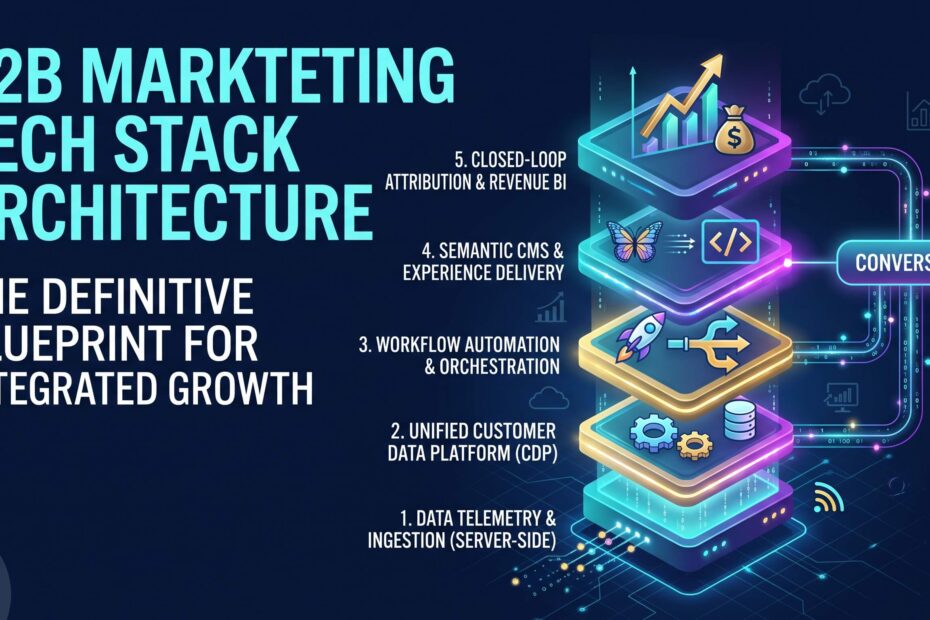
The 5-Layer Architectural Framework
A resilient martech architecture is built in modular tiers. Each layer serves a discrete function while exposing standardized application programming interfaces (APIs) or webhooks to pass contextual event data across the entire ecosystem.
+-------------------------------------------------------------+
| Layer 5: Closed-Loop Attribution & Business Intelligence    |
+-------------------------------------------------------------+
                              ▲
+-------------------------------------------------------------+
| Layer 4: Experience Delivery & Conversion (CMS / DXPs)      |
+-------------------------------------------------------------+
                              ▲
+-------------------------------------------------------------+
| Layer 3: Orchestration, Routing & Workflow Automation       |
+-------------------------------------------------------------+
                              ▲
+-------------------------------------------------------------+
| Layer 2: Customer Data Unification & Identity Resolution    |
+-------------------------------------------------------------+
                              ▲
+-------------------------------------------------------------+
| Layer 1: Data Collection & Behavioral Telemetry             |
+-------------------------------------------------------------+
Layer 1: Data Collection & Behavioral Telemetry
The foundation of any modern stack is accurate, server-side data ingestion. Relying exclusively on client-side JavaScript tags introduces data degradation due to browser ad-blockers, Intelligent Tracking Prevention (ITP), and network latency.
- Server-Side Event Ingestion: Deploy solutions like Server-Side Google Tag Manager (sGTM) or edge-based telemetry routers to process conversion and interaction data directly from your server infrastructure.
- Standardized Event Schemas: Define rigid naming conventions for user actions (e.g.,
account_identified,content_downloaded,demo_requested) before piping data into downstream tools.
Layer 2: Customer Data Unification & Identity Resolution
In high-ticket B2B sales cycles, multiple stakeholders interact with your digital footprint before anyone fills out a form. Identity resolution unifies disparate anonymous sessions with firmographic accounts.
- Customer Data Platforms (CDPs) / Composable CDPs: Utilize modern data-layer solutions (such as Segment, RudderStack, or Reverse ETL tools like Census/Hightouch connected to your Snowflake or BigQuery data warehouse).
- Account-Based Deanonymization: Integrate IP-to-company mapping tools to detect enterprise intent surges and match anonymous traffic patterns to your Ideal Customer Profile (ICP).
Layer 3: Orchestration, Routing & Workflow Automation
Data is useless without programmatic execution. Layer 3 serves as the central nervous system, automating lead routing, enrichment, and nurturing cadences.
- Automated Lead Enrichment: Connect tools like Clearbit or ZoomInfo via webhook to enrich raw incoming form submissions instantly (e.g., pulling industry, company size, and tech stack data without cluttering form fields).
- Speed-to-Lead Routing: Implement automated lead distribution rules (via HubSpot Operations Hub, Zapier Enterprise, or Make) to assign qualified prospects to Account Executives within minutes, not days.
- Dynamic Lead Scoring: Score prospect engagement based on a combination of behavioral activity (e.g., pricing page visits) and demographic fit, dynamically adjusting sales notification thresholds.
Layer 4: Experience Delivery & Semantic CMS (Web Systems)
Your website is not a digital brochure; it is your highest-leverage conversion surface. Modern architectures separate high-performance content delivery from administrative overhead.
- Semantic Headless / Optimized Hybrid CMS: Power your frontend with structured content engines (WordPress REST API, Webflow, or Next.js frontends) that ensure sub-second page loads and pristine Core Web Vitals.
- Dynamic Personalization: Adapt messaging, logos, and case studies based on the visitor’s industry vertical, company size, or referral campaign.
- Structured Semantic Schema: Embed comprehensive JSON-LD schemas (
Organization,TechArticle,SoftwareApplication) so generative AI engines and search crawlers can index and cite your domain authority accurately.
Layer 5: Closed-Loop Attribution & Business Intelligence
The final layer validates marketing investments against closed-won revenue, moving leadership discussions away from vanity metrics (clicks, impressions) and toward unit economics (CAC, LTV, Pipeline Velocity).
- Multi-Touch Attribution (MTA): Model first-touch, lead-creation touch, and opportunity-creation touch to uncover which channels originate and accelerate enterprise deals.
- CRM Synchronization: Maintain a two-way synchronization between your analytics warehouse and your core CRM (HubSpot, Salesforce) to track deals from initial click through expansion revenue.
Evaluating Your Stack: The Architectural Audit Matrix
Before adding new vendors to your budget, run prospective tools through this evaluation matrix:
| Evaluation Dimension | Key Question to Ask | Ideal Standard |
| API Modularity | Does the tool offer REST or GraphQL APIs with robust webhook support? | Bi-directional, real-time webhooks with zero rate-limit bottlenecks. |
| Data Portability | Can we extract raw event logs, or is data trapped in proprietary dashboards? | Full access to raw SQL/JSON event streams. |
| Performance Overhead | What is the script execution payload on frontend page load times? | Server-side execution or asynchronous scripts $< 50\text{ KB}$. |
| Governance & Security | Is the platform compliant with SOC 2, ISO 27001, and global privacy laws? | Enterprise-grade encryption, role-based access, and automated data retention rules. |
Common Architectural Pitfalls to Avoid
- Premature Complexity: Building a bespoke, custom data warehouse pipeline before establishing basic inbound lead flow and repeatable CRM hygiene.
- Ignoring Data Cleansing: Failing to standardize field properties between marketing automation platforms and CRMs, resulting in duplicate or corrupted lead records.
- The “All-in-One” Illusion: Expecting a single legacy suite to solve every niche requirement—often leading to mediocre execution across all functional layers.
The Path Forward: Build for Adaptation
A high-performance B2B marketing tech stack is not a static installation. It is an evolving web system engineered to ingest data, execute automated workflows, and adapt to changing market conditions.
By anchoring your stack in a layered, modular framework, you eliminate data blind spots, empower your sales teams with real-time intelligence, and build a scalable foundation for predictable revenue growth.
Need Specialized Support for Your Digital Infrastructure?
Discover how Hunabkuh designs, builds, and scales integrated Web Systems and Conversion Architecture for growing B2B brands.