
If you oversee marketing for a growing mid-sized business, your weekly organic reporting meetings have likely felt a bit disorienting over the past year.
Perhaps your team has hit target keyword rankings on page one of Google, your domain authority has held steady, and your technical site health score in Ahrefs or Semrush shows a reassuring green checkmark. Yet, your organic inbound leads and raw organic sessions have plateaued—or quietly softened.
You aren’t imagining it, and your team didn’t suddenly forget how to execute traditional SEO.
What has changed is the foundational architecture of the search interface itself. For more than twenty-five years, digital marketing operated on an unwritten covenant with search engines: build indexable, well-structured content, and search engines will route interested prospects directly to your doorstep via a list of ten blue links.
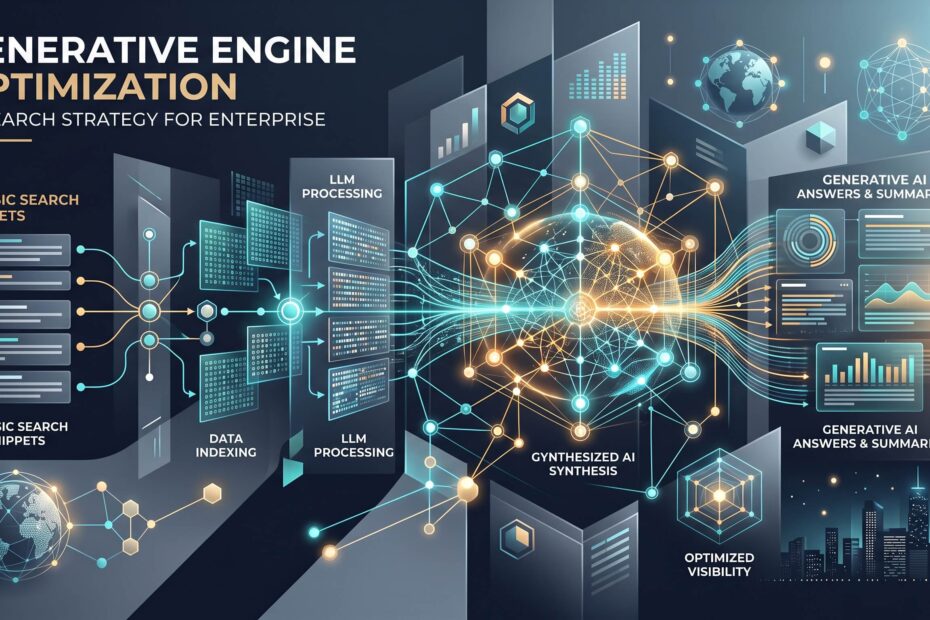
Today, that covenant has evolved. Google AI Overviews, Perplexity, OpenAI Search, and Microsoft Copilot have replaced the traditional index catalog with synthesized answer engines. Prospects are getting granular comparisons, technical explanations, and product recommendations directly inside the search interface without clicking through to individual websites.
Welcome to the zero-click, generative era. Surviving and dominating this shift requires moving beyond standard SEO and engineering a proactive Generative Engine Optimization (GEO) strategy.
Let’s look at what this transition means for mid-market marketing leaders, how Large Language Models (LLMs) decide which brands to cite, and how you can deploy an actionable, resource-efficient GEO playbook without inflating your headcount.
1. Why Mid-Sized Businesses Feel the Squeeze First
Mid-market organizations occupy a distinct operational sweet spot: you are nimble enough to pivot faster than multinational enterprises with bloated governance committees, but you do not have unlimited marketing capital or a nine-figure brand halo that forces AI models to mention your name by default.
When an answer engine compiles a response to an enterprise prompt like:
“What are the most reliable compliance automation platforms for SOC 2 Type II readiness for mid-market healthcare providers?”
The model does not simply crawl page titles and display whoever bought the most backlink packages. Instead, the model evaluates entity relationships, verified consensus, information gain, and source citation trust.
If your brand has relied purely on thin “top-of-funnel” glossaries, generic listicles, or repurposed basic copy, AI engines consume your facts, strip out your attribution, and present the final answer to the prospect—giving you zero visibility and zero pipeline credit.
The risk for mid-sized companies isn’t just dropping from position #2 to position #6 on a keyword list. The actual risk is complete digital invisibility within the conversational decision loop of your buyers.
2. From SEO to GEO: Deconstructing How Answer Engines Work
To retool your organic acquisition funnel, your team must understand how an AI synthesis engine differs from a legacy search crawler:
| Evaluation Dimension | Traditional Search Engine Optimization (SEO) | Generative Engine Optimization (GEO) |
| Primary Goal | Rank URLs on the first page of Search Engine Results Pages (SERPs). | Earn brand citations and authoritative attribution inside LLM-synthesized responses. |
| Target Engine | Web crawlers indexing strings and keyword frequency (Googlebot, Bingbot). | Neural networks evaluating semantic entities, knowledge graphs, and cross-source consensus. |
| User Behavior | Searcher inputs 2–4 keywords, scans links, clicks a snippet, explores the site. | Searcher inputs multi-clause prompts, reads synthesized answers, asks follow-up prompts. |
| Content Currency | Keyword density, URL structure, page speed, backlink quantities. | Information density, proprietary data, entity clarity, third-party citation consensus. |
| Primary Metric | Organic impressions, keyword rank, click-through rate (CTR), raw sessions. | LLM citation share-of-voice, brand sentiment, assisted pipeline conversions. |
Traditional SEO answers: “Where does this document match this search query string?”
Generative Engine Optimization answers: “Which verified market entity provides the most definitive, trustworthy, and non-redundant solution to this user’s complex problem?”
3. The Three Pillars of an Enterprise GEO Framework
A practical GEO strategy does not require abandoning technical SEO fundamentals. Rather, it layers an entity-first, semantic approach on top of your existing digital foundation.
Here are the three structural pillars every marketing director must build into their content and web operations.
                    THE GEO VALUE PYRAMID

                           ▲
                          / \
                         /   \
                        /  3  \   PILLAR 3: Consensus & Digital Footprint
                       /-------\  (Third-Party Reviews, PR, Industry Communities)
                      /    2    \ PILLAR 2: Information Gain & First-Party Data
                     /-----------\ (Original Research, Benchmarks, Calculators)
                    /      1      \ PILLAR 1: Entity Architecture & Semantic Schema
                   /_______________\ (JSON-LD Graphs, Wikidata, Clean Hierarchy)
Pillar 1: Entity Architecture & Semantic Clarity
LLMs organize reality through knowledge graphs and entities (people, places, organizations, concepts, and relationships). If an AI model cannot clearly separate your software or services from adjacent competitors or generic category terms, it will omit you from citations.
To solidify your entity profile:
- Implement Nested JSON-LD Schema: Move beyond basic
WebPageorBlogPostingtags. Implement clearOrganization,Product,SoftwareApplication,About, andMentionsschemas with explicitsameAsreferences pointing directly to your verified profiles (Wikidata, Crunchbase, LinkedIn, official industry directories). - Standardize Naming Conventions: Avoid internal marketing jargon that changes every quarter. Use clear, canonical category names consistently across your website navigation, press releases, case studies, and social footprints.
- Structure Content for Retrieval-Augmented Generation (RAG): When AI search engines pull real-time data from the web, they scrape text chunks. Write in clear, declarative thesis statements. Avoid bury-the-lead storytelling; lead sections with concise, 40-word definitive answers that an LLM can easily lift and credit.
Pillar 2: The “Information Gain” Imperative
Since late 2023, both Google’s ranking algorithms and retrieval pipelines for models like Claude and GPT have heavily favored Information Gain—the inclusion of unique, non-duplicative insights that do not exist elsewhere in the pre-training dataset.
If your marketing agency delivers a 2,000-word post generated simply by running standard SEO competitor outlines through an automated prompt, your content possesses an Information Gain score near zero. The AI already knows everything in that article because it trained on those sources. It has no reason to cite your page.
To guarantee Information Gain, anchor your editorial workflow around:
- Proprietary Benchmark Data: Annual surveys, user telemetry, anonymized customer platform metrics, and pricing research.
- First-Person Subject Matter Expert (SME) Friction: Direct counter-intuitive perspectives from your engineers, product managers, or implementation leads that challenge generic industry conventions.
- Definitive Decision Rubrics: Concrete comparison matrices, ROI formulas, step-by-step implementation sequences, and real-world failure analyses.
Pillar 3: Off-Page Consensus & The Broader Digital Footprint
LLMs do not trust your website solely based on what your website claims about itself. When evaluating whether to recommend your solution, an answer engine cross-references the entire open web to verify if industry peers validate your claims.
This requires your SEO and PR functions to align tightly:
- Earned Community Footprints: Active discussions, technical troubleshooting, and organic brand mentions across platforms like Reddit, specialized Slack/Discord communities, Quora, and Stack Overflow are indexed and prioritized by retrieval engines.
- Independent Review Aggregation: High-integrity G2, Capterra, Gartner Peer Insights, and Trustpilot reviews form a core verification layer for B2B answer engines. If your product has superior features but zero presence on verified review boards, generative engines will consistently recommend your competitors.
- Tier-One Technical Bylines: Guest contributions and executive quotes in credible trade publications validate your company as a recognized entity in your specific niche.
4. Rethinking Marketing KPIs in the AI Era
One of the steepest hurdles marketing leaders face when presenting to the executive committee or board is explaining why traditional Google Analytics dashboards show fluctuating traffic while business revenue remains stable or growing.
In the GEO landscape, traffic volume is a vanity metric; citation frequency and high-intent attribution are commercial reality.
+------------------------------+-------------------------------------+
| Legacy SEO Metric            | Modern GEO Metric                   |
+------------------------------+-------------------------------------+
| Keyword Rankings (Positions) | LLM Citation Share of Voice (SoV)   |
| Raw Organic Pageviews        | Zero-Click Brand Impression Share   |
| Direct Organic Conversions   | Multi-Touch Conversational Leads    |
| Total Backlink Volume        | Entity Co-Occurrence in AI Prompts  |
+------------------------------+-------------------------------------+
How to Track AI Search Visibility Today
- Establish a Synthetic Prompt Benchmark: Identify the top 20 high-intent transactional prompts your potential buyers ask. Run these prompts bi-weekly across Google AI Overviews, Perplexity, and ChatGPT Search. Track whether your brand is cited, what sentiment is attached, and which URLs the engine uses as reference links.
- Monitor “Zero-Click” Lead Self-Attribution: In your contact or demo forms, maintain an open-ended field: “How did you first hear about our solution?” You will quickly see responses shift from “Google search” to “I asked ChatGPT for the top platforms that handle X, and it recommended you.”
- Analyze Referral Logs for AI User-Agents: Keep an eye on server requests and referrers originating from services like
perplexity.ai,chatgpt.com, or native AI browser clients. These visitors typically show significantly higher session durations and purchase intent because the AI engine pre-qualified them prior to the click.
5. A 90-Day Implementation Roadmap for Mid-Sized Marketing Teams
You do not need to pause your existing demand-generation campaigns to start winning in generative search. Use this phased 90-day sprint to operationalize GEO across your organization:
Days 1–30: Audit and Entity Alignment
- Run an LLM Footprint Audit: Query major AI engines using your primary category keywords, product names, and competitor comparisons. Note where your brand is omitted, miscategorized, or hallucinated.
- Refactor Structured Data: Review your high-value product pages and service lines. Ensure all technical schema markup uses valid, comprehensive JSON-LD with unambiguous entity identifiers.
- Consolidate Brand Knowledge Assets: Ensure your “About Us”, leadership bios, corporate address, and service descriptions are standardized across LinkedIn, Wikipedia/Wikidata (if applicable), and industry review repositories.
Days 31–60: Content Transformation & Information Gain
- Audit the Existing Blog Library: Identify articles ranking on page one that are losing traffic to AI overviews. Upgrade them with proprietary surveys, custom diagrams, downloadable calculators, or concrete customer case data.
- Implement the “SME Requirement”: Mandate that no article or whitepaper is published without at least one direct interview with an internal technical or commercial specialist. Remove generic, AI-generated filler that adds no unique value.
- Structure for Snippets: Update article intros and core subheads to feature direct, summary-driven definitions within the first 50–75 words of each section.
Days 61–90: Third-Party Validation & Measurement
- Launch a Dedicated Review Strategy: Incentivize satisfied customer cohorts to leave detailed, specific reviews on G2, Capterra, or Trustpilot detailing explicit use cases and ROI metrics.
- Engage in Industry-Specific Discussions: Build an authentic executive presence on niche forums, Reddit communities, and specialized podcasts where peer-to-peer recommendations occur.
- Roll Out Executive Reporting: Present your first LLM Share-of-Voice report to executive leadership, establishing the link between AI citations and pipeline quality.
6. The Strategic Advantage of Moving Early
Whenever search dynamics change, early movers capture an outsized market share.
In the early 2000s, businesses that recognized the value of Google’s PageRank captured organic dominance that lasted for more than a decade. The transition from static blue links to interactive, generative answer engines is an even larger paradigm shift.
For mid-sized companies, GEO is an equalizer. You do not need the largest media budget in the room to become the verified, cited, and recommended standard in your market. You simply need a coherent entity architecture, undeniable first-party authority, and a disciplined approach to how modern algorithms synthesize human knowledge.
By aligning your web operations with the requirements of generative search engines today, you ensure that as your buyers stop clicking lists and start having conversations, your brand is the definitive answer they receive.