Traditional SEO tracking focused on blue links, rank positions 1 through 10, and target keywords. Modern search engines and Large Language Models (LLMs)—including Google Search Generative Experience / AI Overviews, Bing Copilot, ChatGPT, Perplexity, and Claude—synthesize information differently.
Instead of presenting a page of URL choices, AI answer engines extract entities, parse vector embeddings, evaluate brand sentiment, and assemble definitive direct answers. In this ecosystem, visibility is no longer measured solely by SERP rank. It is measured by AI search visibility and brand citations.
To track brand presence in AI-driven search environments and turn visibility into pipeline revenue, B2B marketing leaders need a dedicated Answer Engine Optimization (AEO) tracking framework.
What Is AI Search Visibility and Brand Citation Tracking?
AI Search Visibility measures how frequently, prominently, and accurately your brand, products, or core value propositions appear inside generative AI search summaries and LLM responses.
Brand Citations are the explicit textual references, linked attributions, or embedded recommendations that an answer engine uses to support its generated response.
Unlike standard Google Search Console impressions, AI citations exist across structured web graphs, retrieval-augmented generation (RAG) pipelines, and proprietary vector databases.
+-----------------------------------------------------------------------+
|                         TRADITIONAL SEO VS. AEO                       |
+-----------------------------------+-----------------------------------+
| Metric / Layer                    | Modern Answer Engine (AEO)        |
+-----------------------------------+-----------------------------------+
| Primary Focus                     | Direct Answers & Entity Mentions  |
| Data Source                       | Web Index + LLM Context Window    |
| Attribution Style                 | Direct Inline Links & Citations   |
| Key Measurement                   | Share of Model (SoM) & Sentiment  |
+-----------------------------------+-----------------------------------+
Step 1: Set Up Key AI Search Tracking Vectors
To monitor brand citations effectively, B2B marketers must track four distinct quantitative and qualitative vectors:
1. Share of Model (SoM) and Prompt Share
Track how often your brand is cited compared to competitors when potential clients ask intent-driven B2B prompts. For example, if ChatGPT or Perplexity is asked “What are the top enterprise marketing automation platforms for SaaS?”, measuring whether your brand appears in 8 out of 10 generation cycles establishes your baseline Share of Model.
2. Citation Domain Authority & Link Attribution
Generative engines rely heavily on high-trust third-party nodes to validate entity claims. Track which domain sources supply the information about your brand to the model. Are citations pulling directly from your site, or from third-party review platforms, industry reports, and authoritative news outlets?
3. Sentiment and Co-occurrence Analysis
LLMs interpret context via vector proximity. Monitor the surrounding tokens when engines mention your brand. Positive co-occurrences like “industry leader,” “scalable,” or “secure” build strong brand associations within the model’s latent space.
4. Referral Traffic from AI Interfaces
Configure custom analytics segments to track direct traffic from AI platforms. Set up filters for referral traffic originating from domains such as:
chatgpt.com/openai.comcopilot.microsoft.com/bing.comperplexity.aiclaude.ai
Step 2: Establish an AEO Tracking Methodology
Monitoring LLM output requires a blend of automated analytics, platform APIs, and programmatic querying.
Programmatic Prompt Auditing
Run regular programmatic prompt runs across major platforms using structured query templates:
- Category Prompts: “What are the best [Service Category] solutions for [Target Industry]?”
- Comparative Prompts: “Compare [Your Brand] vs. [Competitor Brand] for enterprise needs.”
- Problem-Solution Prompts: “How do I solve [Specific Industry Pain Point]?”
By running standardized prompts on weekly or monthly schedules, you can log citation presence, direct link placements, and changing model preferences.
Schema and Entity Graph Monitoring
Ensure your schema markup cleanly feeds knowledge bases like Wikidata and Google Knowledge Graph. Validate that your JSON-LD structures (Organization, Product, Service, Article) are clear, error-free, and updated so LLM web crawlers can ingest precise entity data.
Step 3: Optimize for Brand Citations Across the Web
Tracking reveals your current standing; optimization expands your reach. To increase brand citations across Google, Bing, and standalone AI models:
- Publish Structured, Data-Backed Content: AI models prefer factual, unambiguous, and easily extractable data points. Use structured tables, clear definition headers, and original research.
- Build Third-Party Entity Validation: Secure coverage on industry publications, digital PR outlets, software review hubs, and high-authority platforms that LLMs use as retrieval sources.
- Deploy Schema-Dense Technical Architecture: Structure technical architecture so search bots and AI crawlers can index service offerings without execution barriers or paywalls.
Turn AI Search Visibility into B2B Growth
As search behavior shifts from link clicking to answer consumption, remaining invisible in generative search responses puts pipeline and market share at risk. Integrating AI citation tracking and Answer Engine Optimization into your marketing stack ensures your brand is not only indexed by search engines, but actively recommended by them.
At hunabkuh.com, we help B2B organizations navigate search engine optimization and answer engine optimization. From structured entity mapping to AEO tracking implementation, we build systems that put your brand directly into AI-generated answers.
Featured Image Configuration for WordPress
To set up this article’s featured image in WordPress:
- File Name:
ai-search-visibility-tracking-dashboard.png - Alt Text:
AI search visibility dashboard showing analytics and tracking metrics - Title Tag:
AI Search Visibility and Brand Citation Tracking - Caption:
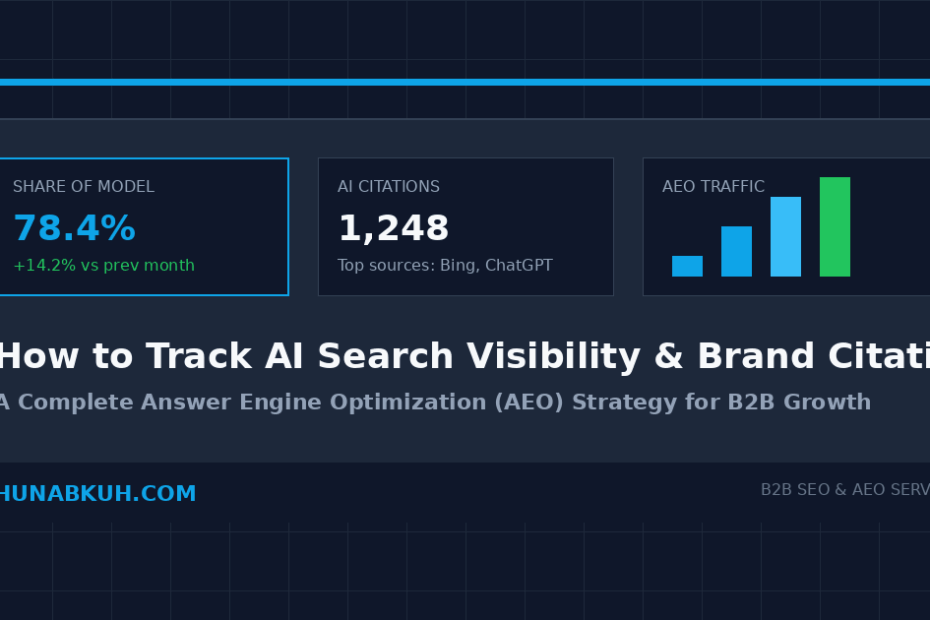
Tracking AI search visibility and brand citations across LLMs and search engines. - Description:
A conceptual digital interface displaying AI analytics, brand citation metrics, and search engine optimization performance for B2B marketers.