
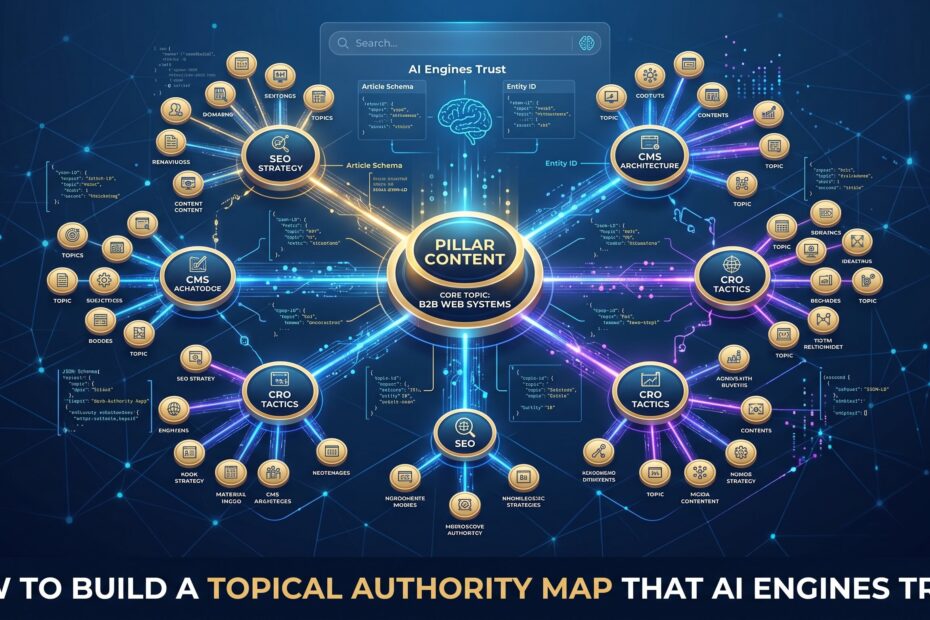
In the age of semantic search, Generative AI, and Answer Engines, the old SEO playbook is obsolete. Ranking #1 for a single, high-volume keyword is no longer the goal. The new imperative is Topical Authority.
AI engines (like Gemini, Perplexity, and Google’s AI Overviews) don’t just count backlinks; they evaluate your website’s depth of knowledge and context on a specific subject. They are entity-based systems that seek comprehensive, structured proof that you understand a topic inside and out.
If you are building specialized Web Systems or driving B2B Growth (like we do at Hunabkuh), you cannot just publish generic content. You need a structural blueprint. You need a Topical Authority Map.
What is a Topical Authority Map?
A Topical Authority Map is a visual and structural representation of all the interconnected content necessary to establish absolute expertise on a specific core topic. It moves your site architecture away from linear lists (like a standard blog roll) and into a semantic network that AI engines can easily digest.
It answers the AI’s core questions:
- Does this domain understand the core problem?
- Does it cover all related sub-topics and context?
- Are the relationships between these entities clearly defined?
The Core Strategy: Pillar-Cluster Architecture
The framework for your map is the Pillar-Cluster model. This creates a clear hierarchy and relationship structure.
- 1. The Pillar Page (The Authority Hub): This is the master entity for your broad topic (e.g., “B2B Web Systems Architecture”). It provides a definitive overview of the subject but links out for detailed specifics.
- 2. Topic Clusters (Supporting Expertise): These are the spokes radiating from the hub. These are highly focused, deep-dive articles on narrow sub-topics (e.g., “Scalable Database Design for B2B Apps,” “API Security Best Practices,” “Migrating Legacy Systems”).
- 3. Hyperlinking (Semantic Pathways): These links do not just direct traffic; they define relationships. Every Cluster page must link back to the Pillar, and relevant Cluster pages should link to each other using precise anchor text.
Step 1: Define the Root Entity and Semantic Universe
Your map begins with the core topic you want to own. This must align with your business offerings and high-intent customer problems.
If the root topic is Specialized B2B Web Systems, we need to map the surrounding semantic universe. This is not just keyword research; it is entity research. We seek all entities related to “B2B Web Systems.”
How to find the entities AI expects:
- Analyze Google AI Overviews (SGE): What related sub-topics does Google synthesize when you search the core term? These are the high-priority clusters.
- Use Wikipedia and Industry Wikis: These demonstrate established knowledge graphs.
- Leverage Semantic SEO Tools: Use entities identified by tools like MarketMuse, Frase, or SurferSEO.
The Semantic Universe Mapping (Hunabkuh Example):
Core Root Entity: Specialized B2B Web Systems Architecture
- Domain Entities: Development, Strategy, CRO, B2B Growth.
- Platform Entities: Content Management Systems (CMS), Headless Architecture, API Integration, Database Design, Scalability.
- User Entities: Enterprise, Small Business, Tech Founders, Procurement, Compliance.
- Metric Entities: Performance, Security (ISO 27001), Operational Efficiency, Technical Debt.
Step 2: Architecting the Map (Pillar-Cluster Design)
Once your semantic universe is identified, translate it into a content architecture. Use a mind-mapping tool (like Miro, XMind, or even a whiteboard) for this visual step.
Hunabkuh’s Specialized Web Systems Map:
Core Pillar: The Definitive Guide to Building Scalable B2B Web Systems in 2026
- Topic Cluster 1: Architecture & Development
- Headless CMS vs. Monolithic: Making the Switch for Agile B2B Teams
- API-First Design: Architecting Microservices for Enterprise Stability
- Serverless Frameworks in B2B: When to Use Them, When to Avoid
- Topic Cluster 2: Strategic Adaptation & Performance
- CRO for Specialization: Post-Launch Optimization on High-Ticket B2B Sites
- Future-Proofing Your B2B Tech Stack Against Technical Debt
- Web Performance Metrics (CWV) and Their Direct Link to B2B Leads
- Topic Cluster 3: Execution, Security & Compliance
- Enterprise Security for B2B SaaS: Moving Beyond the SSL Certificate
- GDPR and B2B Data Compliance: Architecture Considerations
This architecture ensures you do not have isolated content. You have a comprehensive ecosystem.
Step 3: Implement Structured Data Linking (JSON-LD)
To ensure AI engines trust this structure, you cannot just hope they understand it. You must programmatically state it. This requires advanced internal linking supported by Structured Data (Schema).
The Technical Implementation Plan:
1. Internal Link Architecture:
Every single “Cluster” page (spoke) must link to the main “Pillar” page (hub). Use consistent, contextually relevant anchor text.
Example: In the “Headless CMS” post, include a paragraph like: “This approach is central to modern [anchor]b2b web systems architecture[/anchor]…”
2. Advanced Schema Setup (JSON-LD):
Implement structured data linking directly on the page, rather than generic sitewide definitions. This defines the meaning of the content.
On the Pillar Page (“The Definitive Guide to B2B Web Systems”): Use WebPage or Article Schema that includes the about property, explicitly naming the core entity (“B2B Web Systems”). Also use mentions schema for high-priority cluster topics.
On the Cluster Pages (“Headless CMS” post): Use Article Schema where the article isPartOf the collection. Critically, add the mainEntityOfPage pointing directly back to the Pillar Page URL.
JSON
/* Example JSON-LD for a CLUSTER Page */
{
  "@context": "https://schema.org",
  "@type": "TechArticle",
  "headline": "Headless CMS vs. Monolithic: An Agile B2B Guide",
  "isPartOf": {
      "@type": "CollectionPage",
      "name": "B2B Web Systems Architecture Series",
      "@id": "https://hunabkuh.com/pillar-page-url/#collection"
  },
  "about": [
      {
          "@type": "Thing",
          "name": "Headless CMS",
          "sameAs": "https://en.wikipedia.org/wiki/Headless_content_management_system"
      }
  ],
  "mainEntityOfPage": {
      "@type": "WebPage",
      "@id": "https://hunabkuh.com/pillar-page-url/"
  }
}
Step 4: The Final Polish: Semantic Coverage and Information Gain
Now that the map and structure are built, the content itself must deliver semantic depth. A Topical Authority Map fails if the underlying content is shallow.
When drafting (or using an LLM like Gemini for assistance), focus on:
1. Zero-Volume Entity Keywords:
Don’t just chase high-volume phrases. Include the precise technical terminology, edge cases, and synonyms associated with the entity you are covering. If you are discussing “API Security,” don’t ignore “OAuth 2.0” and “Rate Limiting,” even if those terms have low search volume. Their inclusion builds context.
2. Radical Information Gain:
AI engines reward original content. Ask yourself: What does this piece add that is missing from the top 5 results on Google?
- Insert proprietary frameworks (like our Strategy $\rightarrow$ Execution $\rightarrow$ Adaptation model).
- Add original diagrams or technical schematics.
- Provide a contrarian perspective (backed by data).
Summary
A Topical Authority Map is not a one-time project; it is a structural commitment to expertise. It provides the architectural proof that your domain is not just a collection of keywords, but a trusted knowledge graph in the eyes of modern AI engines. This structured approach moves beyond visibility and into sustainable domain trust.