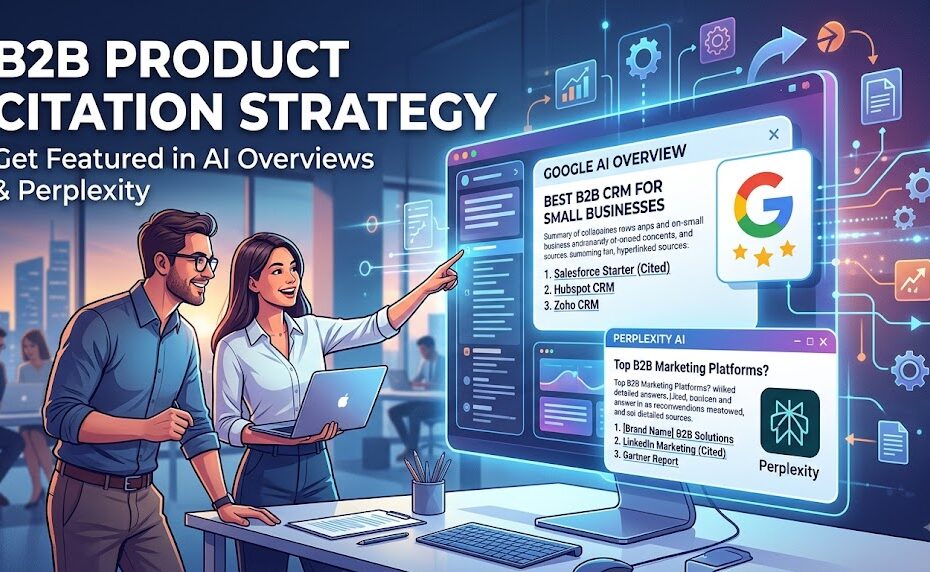
The digital search landscape is undergoing a monumental shift. Traditional Search Engine Result Pages (SERPs)—long dominated by ten blue links—are rapidly giving way to generative search engines and answer engines. Google’s AI Overviews (formerly SGE) and standalone engines like Perplexity AI, ChatGPT Search, and Claude are changing how decision-makers find software, tools, and enterprise services.
For B2B companies, this represents both a risk and a massive opportunity. Buyers are no longer browsing five different product comparison blogs; they are asking Perplexity, “What are the best enterprise CRM solutions for supply chain management?” or viewing Google AI Overviews that summarize top B2B tools directly at the top of the search page.
If your product isn’t cited in those AI-generated answers, you effectively don’t exist to a growing segment of modern tech buyers.
In this comprehensive guide, we’ll explore how AI engines aggregate B2B product data, why traditional SEO isn’t enough anymore, and a step-by-step framework to ensure your B2B products are cited as top-tier recommendations in AI Overviews and Perplexity.
Understanding Generative Engine Optimization (GEO)
To rank or get cited in conversational AI, you need to understand Generative Engine Optimization (GEO). Unlike traditional SEO, which focuses on keyword density, backlinks, and technical site structure to rank a specific URL, GEO focuses on entity authority, brand consensus, and structured knowledge availability across the entire web.
When an AI model generates an overview or answer for a prompt, it follows a multi-step process:
- Intent & Entity Parsing: The model breaks down the query to identify key entities (e.g., “B2B accounting software”, “mid-market”, “integrates with Salesforce”).
- Real-Time Retrieval (RAG): Tools like Perplexity and Google AI Overviews use Retrieval-Augmented Generation to search trusted third-party sites, databases, and indexes in real time.
- Consensus & Synthesis: The model reads multiple sources, evaluates agreement across independent reviews and documentation, and synthesizes a concise recommendation with inline citations.
To win a spot in that synthesis, your product must be widely validated across sources the LLM trusts.
Step 1: Dominate Third-Party Review Ecosystems
AI search engines rarely rely solely on a company’s owned website to verify claims. Because vendor websites are inherently biased, LLMs heavily weight third-party review platforms and unbiased aggregator sites.
For B2B tech and service providers, your presence on review sites acts as primary grounding data for AI answers.
Focus on Key Platforms:
- G2, Capterra, and TrustRadius: These platforms are repeatedly crawled by search engines and cited by Perplexity. High rating volume, recent reviews, and detailed feature breakdowns give the AI confidence in your product’s category.
- Gartner Peer Insights & Forrester: Critical for enterprise-tier queries.
- Vertical-Specific Review Sites: Industry-specific review portals often carry immense weight in niche AI queries.
Actionable Tip:
Encourage reviewers to mention specific use cases, company sizes, and integration partners in their feedback. When a user asks Perplexity for a “B2B tool that integrates with HubSpot for healthcare compliance,” the LLM looks for these exact semantic pairings within trusted review text.
Step 2: Leverage “Digital PR” and Unbiased Industry Roundups
When an AI engine searches the web to build an AI Overview, it frequently synthesizes content from industry blogs, news outlets, and comparative “Best Of” roundups.
If ten independent articles list your product as a top solution for a specific problem, the AI will infer a strong statistical likelihood that your product belongs in the generated answer.
Strategies for Mentions:
- Affiliate & Co-Marketing Partnerships: Work with industry publications and niche tech bloggers who already rank for “Best [Your Category] Tools” queries.
- Expert Quote Distribution: Submit insights to journalists via platforms like Qwoted or Connectively (formerly HARO). When journalists quote your team as category experts, it builds brand-entity association in LLM training and retrieval datasets.
- Podcast & Webinar Transcripts: Modern AI engines index video/audio transcripts. Appearing on recognized B2B podcasts expands your brand footprint into conversational language datasets.
Step 3: Optimize Owned Content for Direct AI Retrieval
While third-party validation is essential, your own website must provide clear, machine-readable facts that AI crawlers can easily digest without hallucination.
Key On-Page Tactics:
- Clear Entity Definitions: On your product pages and homepage, explicitly define what your product is, who it is for, and what core problem it solves in clear, direct language. Avoid excessive marketing fluff or ambiguous jargon.
- Implement Schema Markup: Use
Product,SoftwareApplication,Organization, andFAQPageschema. Structured data makes it easy for bots to parse pricing models, features, ratings, and vendor information. - Publish Detailed Comparison Pages: Create dedicated “Product A vs. Product B” or “Top Alternatives to [Competitor]” pages. Present accurate, factual comparisons. When Perplexity generates a comparison matrix, it often pulls structure directly from clear, objective comparison tables on vendor sites.
- Answer Long-Tail Questions Direct: Use clear heading structures (
H2,H3) formatted as direct questions (e.g., “How does [Product] handle SOC2 compliance?”), followed immediately by a direct, concise answer.
Step 4: Build a Strong Digital Footprint on Reddit and Community Hubs
Perplexity, Google, and OpenAI have established direct data partnerships or heavy crawling pipelines with community platforms—most notably Reddit, Quora, and specialized forums (like Stack Overflow or Tech Community hubs).
Real human recommendations on forums are treated as high-value signals for “authentic opinion.”
How to Engage Authentically:
- Monitor Relevant Subreddits: Identify subreddits where your target B2B buyers ask for recommendations (e.g., r/sales, r/devops, r/marketing, r/sysadmin).
- Provide Value First: Don’t just post sales pitches. Engage in discussions, answer technical questions thoughtfully, and mention your tool transparently when relevant to the context.
- Maintain Documentation Threads: Encourage satisfied customers and community members to discuss their technical implementations publicly.
Step 5: Measure and Track Your AI Visibility
Optimizing for AI Overviews and Perplexity requires a shift in how you measure performance. Traditional click-through rates (CTR) may decrease for simple queries, but qualified conversions from AI citations are often significantly higher because the buyer has already been pre-vetted by the answer engine.
Metrics to Track:
- Brand Mentions in AI Answers: Audit top 20–30 buyer queries in Perplexity, ChatGPT Search, and Google AI Overviews every month to track citation presence.
- Referral Traffic from AI Engines: Set up custom analytics segments to monitor traffic coming from domains like
perplexity.ai,chatgpt.com, or search engine referral pathways carrying generative parameters. - Share of Voice (SOV) against Competitors: Document how often your product is cited compared to your top 3 competitors for core category prompts.
Final Thoughts
Securing citations in AI Overviews and Perplexity isn’t about gaming an algorithm; it’s about establishing undeniable brand authority, consensus, and clarity across the entire web ecosystem.
By combining strong third-party reviews, structured technical data on your website, active community engagement, and digital PR, your B2B product will become the natural, authoritative choice when AI engines generate answers for high-intent buyers.